Short answer: WhatsApp Business API itself has no subscription fee — Meta charges per delivered message, from roughly $0.004 for a utility message up to $0.1365 for a marketing message, and your Business Solution Provider (BSP) adds a markup on top of that, either per-message or as a flat monthly fee. For most small and mid-size businesses in India, that per-message model works out more expensive and harder to predict than a flat monthly subscription like Wappiko's ₹599–1,099/month plans — this guide breaks down exactly why.
How Meta Actually Prices the WhatsApp Business API
Since July 2025, Meta charges per delivered template message, priced by category and by the recipient's country. There's no monthly platform fee from Meta itself — access to the WhatsApp Business Platform, including the Cloud API, is free. What you pay for is volume.
The Three Message Categories
| Category | Price per Message | Used For |
|---|---|---|
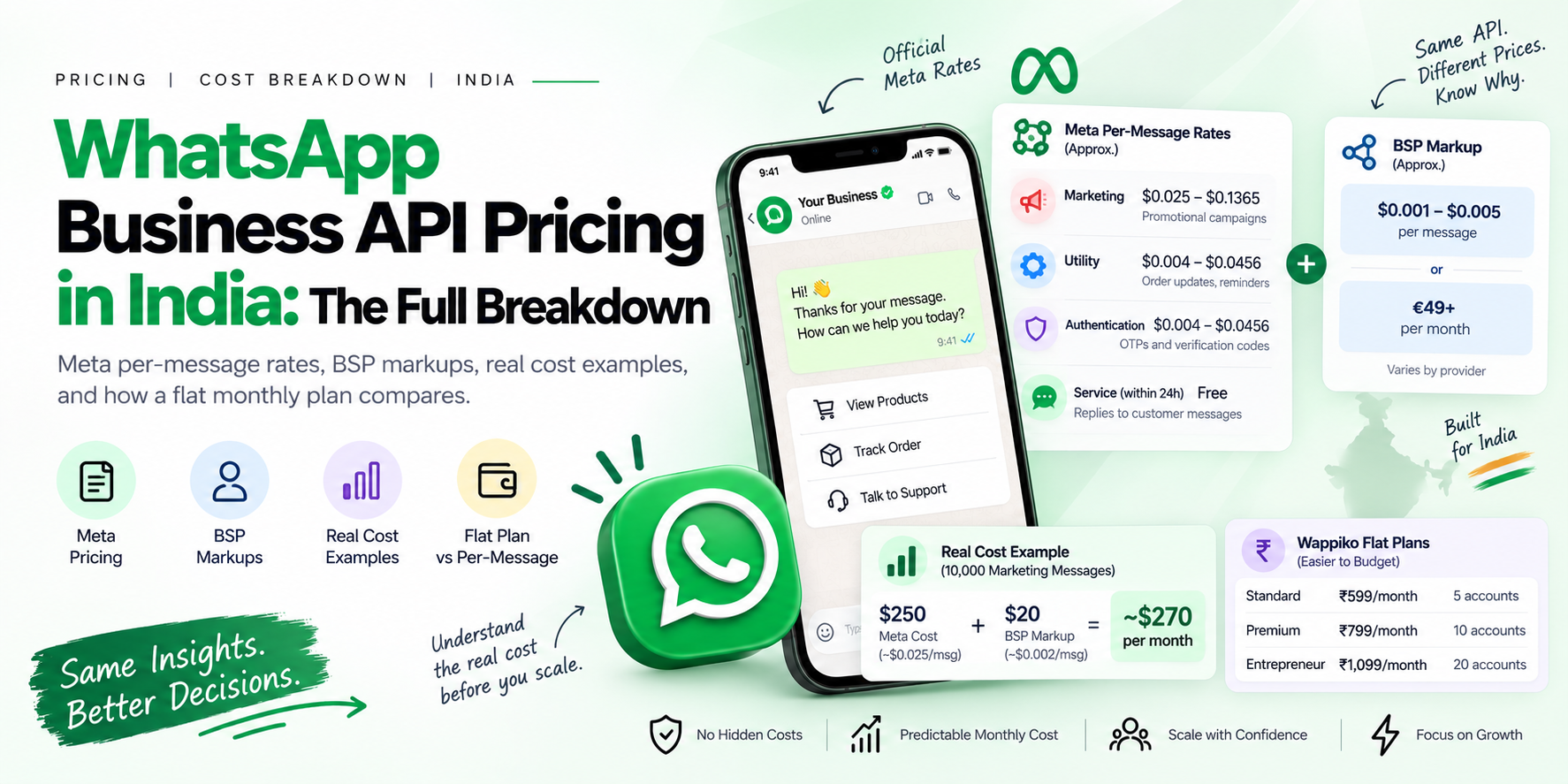
| Marketing | $0.025 – $0.1365 | Promotional campaigns — most bulk messaging falls here |
| Utility | $0.004 – $0.0456 | Order confirmations, shipping updates, appointment reminders |
| Authentication | $0.004 – $0.0456 | OTPs and login verification codes |
| Service (within 24h) | Free | Replies to a customer who messaged you first |
Then Your BSP Adds a Markup
Meta doesn't let most businesses connect to the Cloud API directly — you go through a Business Solution Provider. BSPs add their own markup on top of Meta's rate, typically $0.001 to $0.005 per message, or a flat monthly license starting around €49 and up. So your real cost is always Meta's rate + your BSP's markup, and that second number varies a lot by provider.
What This Actually Costs at Bulk-Messaging Volume
Here's where the per-message model gets expensive fast. Say you're sending 10,000 marketing messages a month to customers in India:
| Monthly Volume | Meta Cost (~$0.025/msg) | + BSP Markup (~$0.002/msg) | Total |
|---|---|---|---|
| 10,000 messages | $250 | $20 | ~$270/month |
| 50,000 messages | $1,250 | $100 | ~$1,350/month |
And that number grows linearly with every campaign you run — before any BSP markup, at even the lower end of Meta's marketing rate.
This is the part BSPs don't always lead with: the official Cloud API's per-message pricing means your cost scales directly with how much marketing you actually do. Run a bigger campaign, pay a bigger bill — every single month.
The Alternative: A Flat Monthly Subscription
Wappiko runs on a different model entirely: you pay a flat monthly fee based on how many WhatsApp accounts you connect, not how many messages you send.
| Plan | Monthly | Annual | Connected Accounts |
|---|---|---|---|
| Free Trial | ₹0 (7 days) | — | Included |
| Standard | ₹599 | ₹4,999 | 5 |
| Premium | ₹799 | ₹7,499 | 10 |
| Entrepreneur | ₹1,099 | ₹10,999 | 20 |
Every plan includes the full toolset — bulk campaigns, the chatbot flow builder, drip automation, and API access. No message credits to track, no per-message billing to reconcile at the end of the month, and no bill that grows every time you run a bigger campaign.
Which Model Actually Makes Sense for You
-
High message volume, need official Meta compliance/verification badge: the Cloud API + BSP route is the only option — you're trading a variable, volume-linked bill for that official status.
-
Steady monthly campaigns, want predictable costs: a flat subscription like Wappiko's is usually cheaper and easier to budget once your volume goes past a few thousand messages a month.
-
Just starting out, testing what works: start with a free trial on a flat plan before committing to a per-message billing relationship you can't easily estimate in advance.
Common Pricing Questions
Does WhatsApp Business API have a free tier?
Service messages (replies within 24 hours of a customer messaging first) are always free under Meta's own pricing. Beyond that, "free" usually means a trial period from your provider, not an ongoing free message allowance.
Why do BSP prices vary so much for the "same" API?
Because BSPs are reselling access to the same underlying Meta infrastructure, but layering their own dashboard, automation tools, and markup on top. The API itself is identical — what you're actually paying different amounts for is the software built around it.
Is a flat subscription actually cheaper than per-message pricing?
It depends entirely on your volume. At very low volume (a few hundred messages a month), per-message pricing can work out cheaper. Past a few thousand messages a month — which is most active bulk-marketing use cases — a flat plan is usually the more predictable and often cheaper option, since your bill doesn't grow with every campaign.
The Bottom Line
There's no single "WhatsApp Business API price" — it's Meta's per-message rate, plus whatever your BSP adds on top, multiplied by however many messages you send that month. If that variability is more than you want to manage, a flat monthly plan gives you the same core toolset — bulk campaigns, chatbots, automation — without the bill changing every time your marketing does.
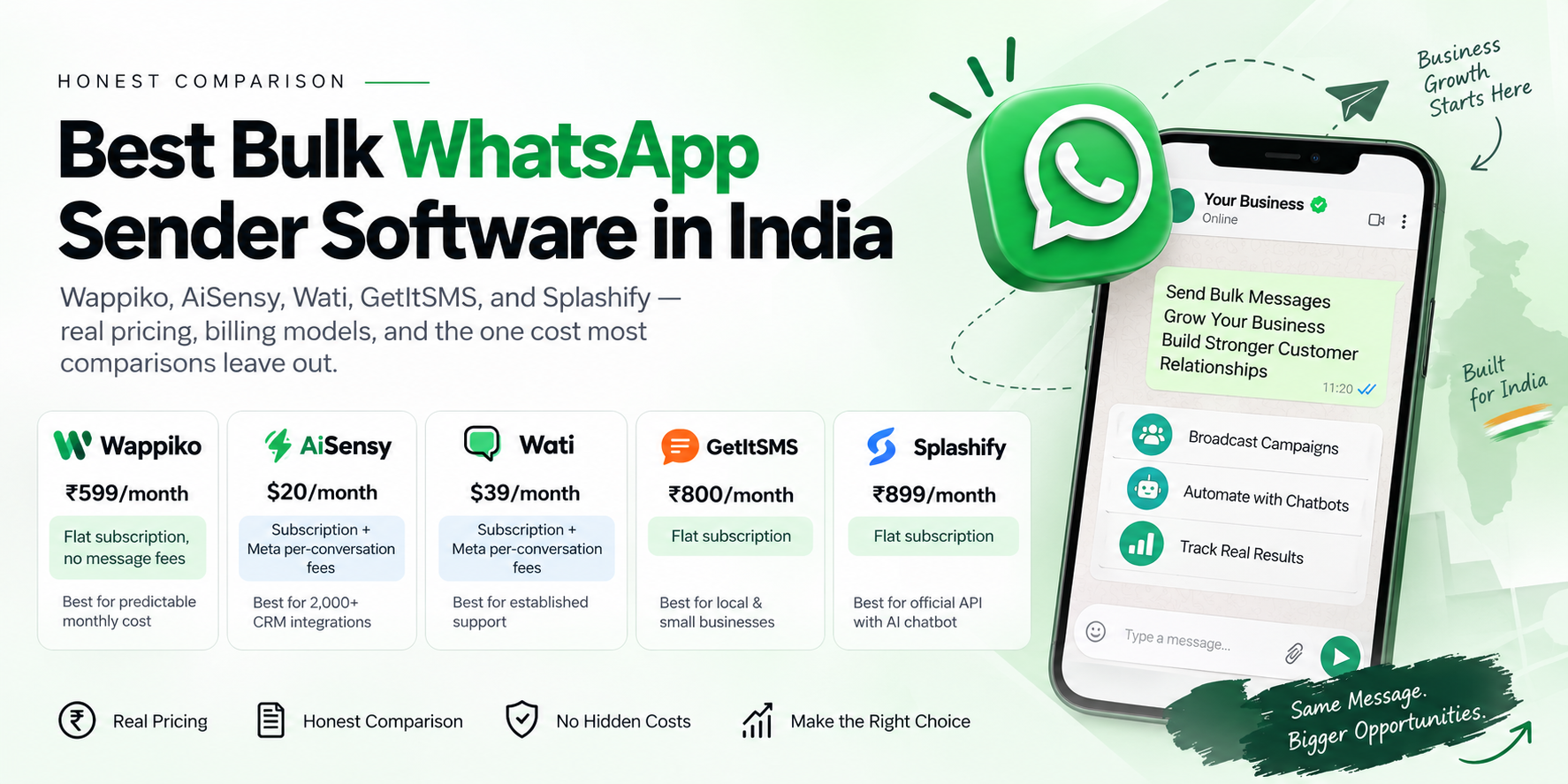
Curious how Wappiko stacks up against AiSensy, Wati, and other bulk-sending tools on actual pricing? See our honest comparison of bulk WhatsApp sender software in India.
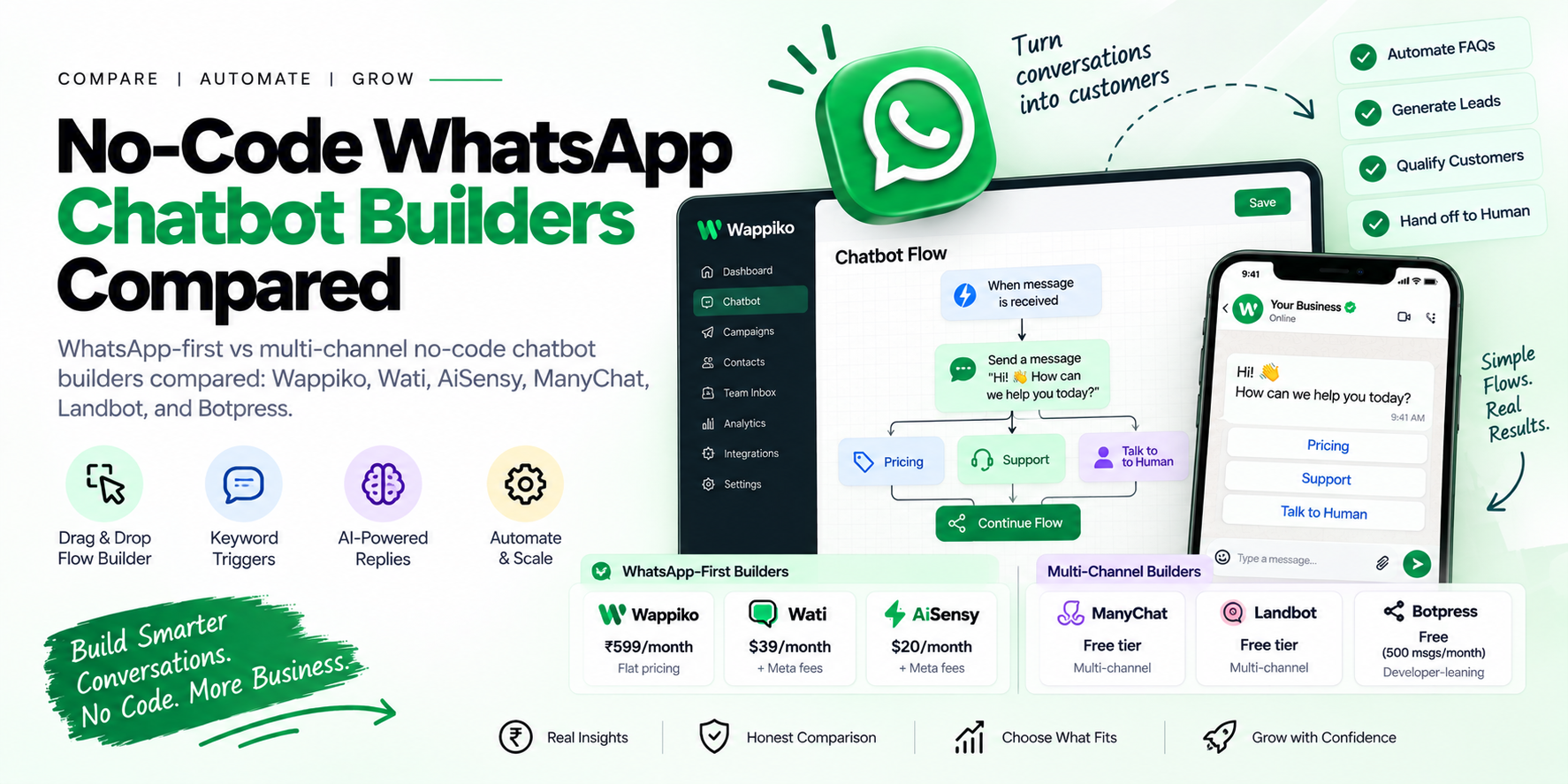
Also running (or considering) a chatbot alongside your campaigns? See our comparison of no-code WhatsApp chatbot builders.
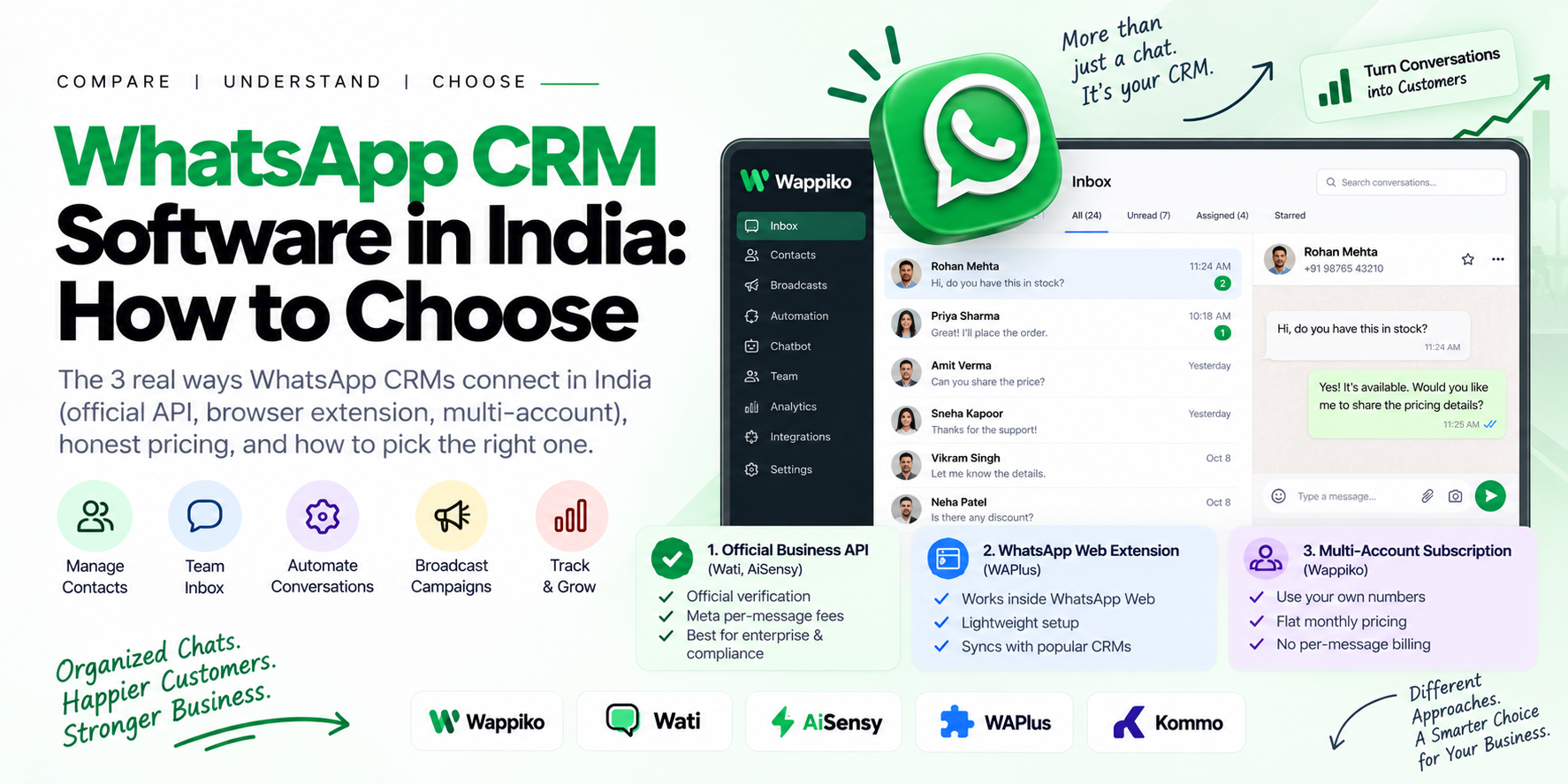
If you are comparing full WhatsApp CRM platforms rather than just bulk-sending tools, see our guide to choosing a WhatsApp CRM in India.
Start your free 7-day trial and see the flat-rate model in action, or check the full pricing page for the complete feature breakdown.